
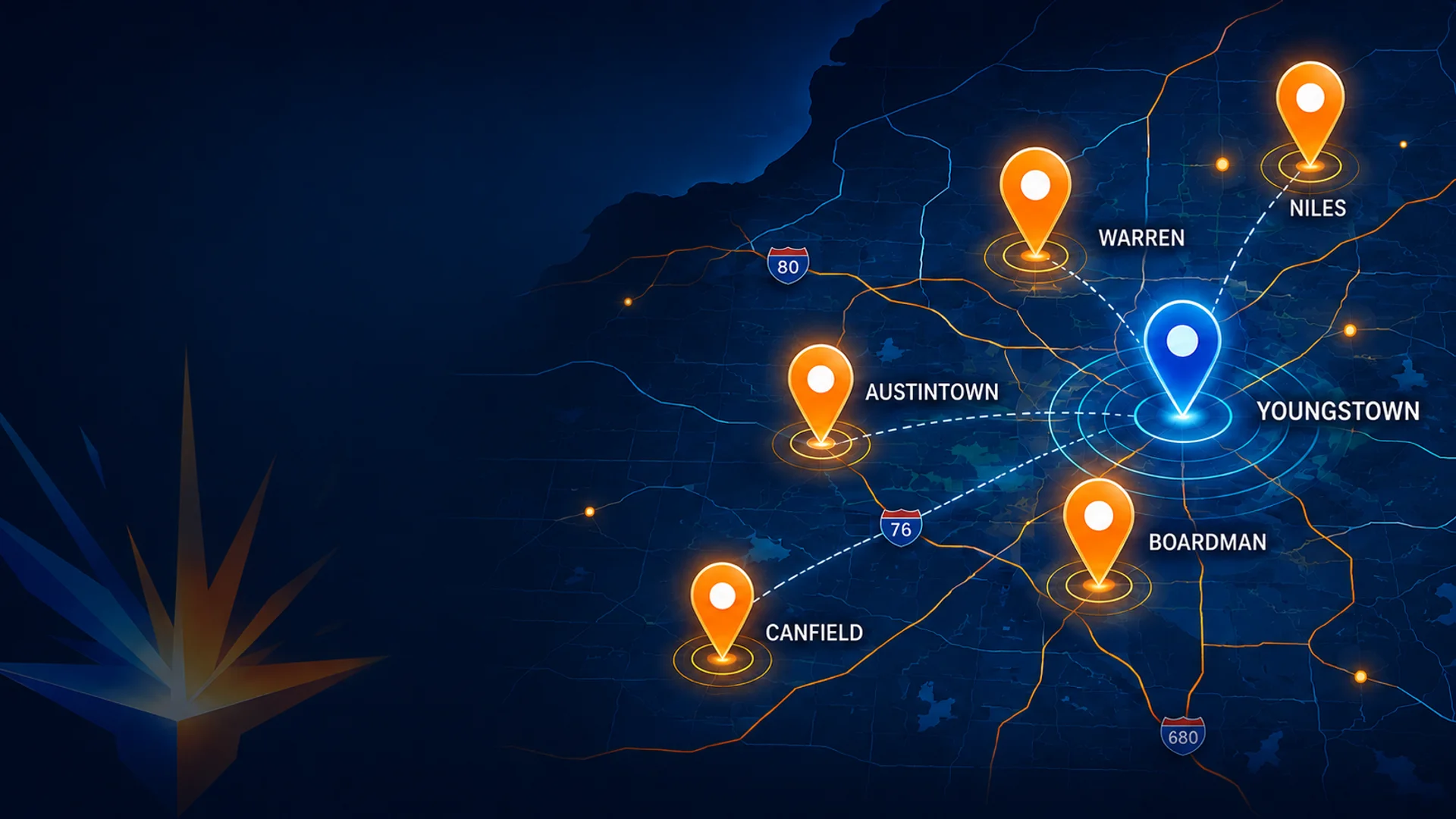

If you’ve ever Googled “plumber near me” or “HVAC repair Youngstown,” you’ve seen the Google Map Pack. It’s the block of three local business listings — with a small map — that appears above all other search results.
Most contractors know it exists. Very few understand what actually determines who’s in it.
That matters, because the Map Pack drives more calls than any other placement on the page. More than paid ads. More than the organic results below it. If you’re a home service contractor in Ohio and you’re not in the Map Pack for your primary trade and city, you’re losing calls to someone who figured this out before you did.
Here’s exactly how it works.
What the Map Pack Is (and What It Isn’t)
The Google Map Pack — also called the Local Pack or 3-Pack — is a set of three business listings Google shows for searches with local intent. “Plumber near me.” “HVAC contractor Youngstown Ohio.” “Emergency electrician Warren Ohio.” Any search where Google determines the user wants a nearby business gets a Map Pack.
What it shows:
- Business name
- Star rating and review count
- General location (neighborhood or city)
- Phone number (on mobile — this is a direct tap-to-call)
- Business category
- Hours (open/closed status)
- Photos from your Google Business Profile
A potential customer can see all of this without clicking your website. On mobile — where the majority of contractor searches happen — they can call you directly from the Map Pack result. This is why Map Pack placement converts at a higher rate than website visits.
What it isn’t: The Map Pack is not Google Ads. It’s not paid placement. You cannot buy your way into it. The positions are determined entirely by Google’s algorithm, which is why contractors who understand that algorithm have a significant and durable competitive advantage.
The Three Factors Google Uses to Rank the Map Pack
Google’s official documentation describes three primary ranking factors for local results: relevance, distance, and prominence. Google’s guide on how local results are ranked defines these factors directly — and understanding each one is the foundation of every Map Pack optimization decision. Here’s what each actually means in practice.
Relevance — Does Your Business Match What They’re Searching For?
Relevance is about how well your Google Business Profile matches the search query. An HVAC contractor whose GBP is categorized as “HVAC Contractor” will be more relevant to “HVAC contractor Youngstown” than one categorized as “Air Conditioning Repair Service.”
The primary category on your GBP is the single most important relevance signal. Choose it carefully — it should match the way customers search for you, not the way you’d describe yourself to a fellow contractor.
Secondary categories expand your relevance. An HVAC company that installs both heating and cooling systems should list both “HVAC Contractor” (primary) and “Air Conditioning Contractor” and “Heating Contractor” as secondary categories.
Your business description, services list, and even the keywords in your customer reviews all contribute to relevance. This is why responding to reviews with natural language about your services (“glad we could help with your furnace repair in Boardman”) actually helps your rankings.
Distance — How Close Is Your Business to the Searcher?
Distance is calculated from the searcher’s location (or the location they specify in the search) to your business’s verified location.
For contractors, this creates a challenge: if your shop is in Youngstown but your customer is in Warren, you’re at a distance disadvantage against Warren-based competitors — even if you serve Warren every day.
The fix is your GBP service area. Setting your service area to include Trumbull County, Warren, Niles, and Cortland tells Google that you serve those areas, which partially offsets the distance disadvantage. It won’t fully eliminate it — a Warren-based contractor will still have an edge for Warren searches — but it’s much better than not setting it at all.
This is also why having location-specific landing pages on your website reinforces your service area claims. A page titled “Plumber in Warren Ohio” signals to Google that you genuinely serve Warren, not just that you’ve listed it in your service area settings.
Prominence — How Well-Known and Trusted Is Your Business?
Prominence is the most complex factor and the one with the most variables. It’s Google’s attempt to measure how well-known and trusted your business is — both online and in the real world.
The signals that drive prominence:
Review count and recency. More reviews = more prominent. Recent reviews matter more than old ones. A contractor with 12 reviews posted in the last 90 days will often outrank one with 60 reviews where none are newer than 18 months. BrightLocal’s Local Consumer Review Survey documents how review volume and recency directly shape customer trust and selection behavior for local service businesses.
Review quality and response. Google reads review text. Reviews that mention your trade, city, and specific services (written naturally by customers) strengthen your relevance and prominence simultaneously. Responding to reviews — especially with natural language that includes relevant keywords — contributes to this.
Website authority. Google cross-references your GBP with your website. A website that loads fast, has proper schema markup, targets local keywords, and has inbound links from other reputable sites signals legitimacy and expertise.
Citation consistency. Your business name, address, and phone number appearing consistently across Yelp, BBB, Angi, and 40+ other directories tells Google your business information is accurate and trustworthy. Inconsistencies — different phone numbers, abbreviated street names, old addresses — reduce your prominence score. Whitespark’s annual Local Search Ranking Factors study ranks citation consistency as a top-ten local ranking signal, and citation errors are one of the most common hidden suppressors of Map Pack visibility for home service contractors.
Engagement signals. How many people click your phone number, request directions, or visit your website from the Map Pack result. This is one reason GBP photos matter — profiles with more photos get more clicks, which signals engagement.
Why Paid Ads Don’t Help Your Map Pack Ranking
This is one of the most common misconceptions in contractor marketing: “If I run Google Ads, will I rank better in the Map Pack?”
The answer is no. Map Pack rankings and Google Ads are entirely separate systems. Running paid search ads has zero influence on your organic Map Pack position. Similarly, ranking well in the Map Pack does not reduce your ad costs.
Google does offer “Local Services Ads” — a separate paid product that appears above the regular Map Pack — but these are distinct from the organic Map Pack listings. Many contractors run both. The organic Map Pack positions are never for sale.
This is also why Map Pack rankings are so valuable: once you earn them through legitimate optimization, you keep them (roughly) without ongoing per-click costs. The work you do in month one keeps generating calls in month twelve.
What the Map Pack Looks Like for Ohio Contractors Right Now
In most Mahoning Valley and Trumbull County markets, the Map Pack is winnable. Unlike Cleveland or Columbus — where well-funded marketing agencies have been optimizing for years — most Map Pack positions in Youngstown, Warren, Boardman, and Niles are held by contractors who showed up early without much competition, not contractors who have systematically optimized.
That’s a window. It won’t stay open indefinitely.
The contractors ranking in the Youngstown Map Pack for most trades right now have between 20–80 Google reviews, GBPs that are mostly complete but not fully optimized, and websites that are functional but not competitive. None of that is impossible to beat with a focused 90-day effort.
The Fastest Way to Move Your Map Pack Ranking
In order of impact:
- Audit your Google Business Profile completely. Category, service area, business hours, photos, services list — every field should be filled in. If it’s not, fill it in today.
- Get 20+ recent reviews. Build a system. Ask every customer. Make it easy. This is the single highest-leverage action most contractors can take.
- Fix your NAP consistency. Every directory, every listing — your business name, address, and phone number must match exactly.
- Build or improve your website’s local relevance. Location-specific pages, LocalBusiness schema markup, fast load times. Google cross-references your GBP against your website constantly.
- Post to your GBP weekly. It signals active management and keeps your profile fresh in Google’s eyes.
None of these steps require a large budget. They require consistency over 60–90 days. Sterling Sky’s local SEO research has repeatedly documented through controlled tests that GBP category selection and review velocity produce the most reliable and fastest Map Pack movement — consistent with the priority order above.
For how these principles apply to specific trades, see our guide on HVAC contractor marketing in Youngstown and the top local SEO tips for plumbers in the Mahoning Valley.
If you want to know exactly where your business currently stands in the Map Pack — and what it would take to reach the top 3 for your trade in your market — get a free local SEO audit. We run this analysis for Ohio contractors every day. You can also learn more about our local SEO service for contractors and see exactly what we do to move businesses into the top 3.
Apply This to Your Business
Know Where You Actually Stand
We audit contractor websites for free — and we'll tell you exactly which of these strategies applies to your business. No pitch. Just findings.
Get Free Audit →