
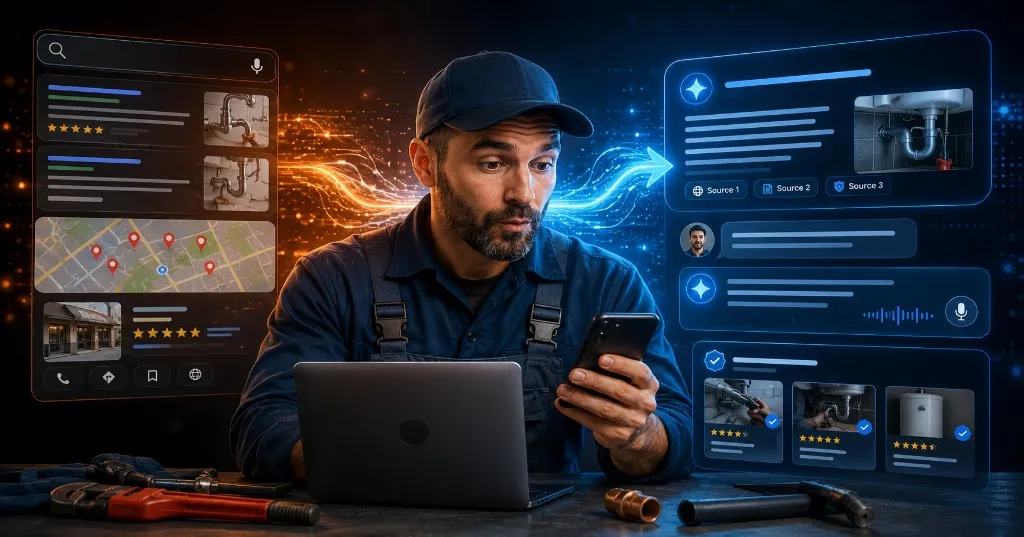

Something changed in 2025 that most contractors haven’t caught up to yet. When Google activated AI Overviews at scale across the United States, a new answer layer appeared above everything on the search results page — above the Map Pack, above paid ads, above every blue link you’ve spent years trying to rank for. Suddenly, being number one in organic results wasn’t enough. If your business wasn’t cited in the AI-generated answer at the very top, you were invisible to a meaningful slice of searchers before they ever scrolled.
That’s the world contractors are operating in now. And understanding the difference between what got you here and what gets you cited going forward is the single most important thing you can do for your online visibility in 2026.
The Short Answer: SEO Is Not Dying, But It’s Being Layered
Let’s clear this up immediately: SEO is not dead. Anyone telling you to abandon traditional search optimization in favor of pure “AI optimization” is selling something.
What’s actually happening is layering. Traditional SEO — ranking in Google’s blue links, appearing in the Map Pack, getting organic clicks — remains the foundation. A contractor who can’t rank locally for “HVAC repair Youngstown” isn’t going to suddenly appear in AI-generated answers either. The signals overlap heavily.
Answer Engine Optimization (AEO) is the layer that sits on top. Where SEO is about earning position in a ranked list, AEO is about being selected as the source an AI tool cites when it synthesizes an answer. Those are different challenges, and they require different signals. A page can rank #3 organically and never get cited in an AI Overview. A page structured specifically to answer questions can get cited even when it isn’t ranking on page one.
The contractors who win in 2026 are building for both simultaneously — not choosing between them.
What Changed When Google Added AI Overviews
Google’s AI Overviews began rolling out in the U.S. in mid-2024 and accelerated through 2025. By early 2026, they appear for a substantial share of queries — including many local service searches that contractors depend on. Queries like “best plumber near me,” “how much does a roof replacement cost in Ohio,” and “emergency HVAC repair Youngstown” increasingly return an AI-generated answer block above the traditional results.
These answer blocks don’t work like traditional rankings. Google’s AI pulls from its index of already-crawled pages, but the content it selects to synthesize and cite follows different rules:
- Specificity wins over generality. A page that directly states “We charge $85–$140 for a standard drain cleaning in Mahoning County” is more citable than one that says “competitive pricing for all plumbing services.”
- Structure matters more than word count. A 600-word service page with clear headings, a FAQ section, and schema markup outperforms a 2,000-word wall of text with no hierarchy.
- Factual claims beat marketing language. AI systems synthesize facts, not slogans. “Licensed in Ohio since 2011” gets cited. “The best plumbers in northeast Ohio” does not.
According to Search Engine Land’s ongoing AI Overview coverage, the content AI Overviews cite most consistently is well-structured, locally specific, and authoritative — not the content with the highest traditional ranking signals.
What AEO Actually Means for a Youngstown Plumber
Here’s a concrete scenario. A homeowner in Boardman wakes up to a slab leak. They open Google on their phone and type “best plumber Youngstown Ohio.” What they see at the top of the page isn’t the Map Pack — it’s an AI Overview that synthesizes a three-sentence answer mentioning two or three specific plumbing companies with brief descriptions of why they’re recommended.
AEO is the practice of structuring your website so your business is one of those names.
It means your service pages directly answer the questions homeowners actually ask. It means your site has FAQPage schema that gives AI crawlers a machine-readable map of your Q&A content. It means your business is a coherent entity across Google Business Profile, your website, and third-party directories — so AI systems can confidently attribute specific claims to you.
It does not mean gaming a new algorithm or paying for inclusion. The contractors getting cited are the ones whose content is genuinely useful and precisely structured. That’s what our AI Optimization service is built around — and it’s why AEO and traditional SEO compound each other rather than compete.
Six Things Contractors Need to Do Differently in 2026
1. FAQ Depth + FAQPage Schema
A single FAQ section with three generic questions isn’t enough anymore. AI systems look for pages that answer the full spectrum of questions around a topic — pricing, timeline, process, qualifications, service area, and what can go wrong.
Every core service page needs at minimum five to eight real Q&A pairs, written the way customers actually ask: “How long does a water heater installation take?” not “Installation timeline.” Those Q&As then get wrapped in FAQPage schema so AI crawlers can extract them as structured machine-readable data, dramatically improving citation likelihood in Google AI Overviews and ChatGPT Search alike.
2. Citation Patterns AI Engines Look For
AI systems are trained to trust sources that behave like authoritative sources — which means they look at whether your content cites its own claims. A plumber who states “According to the EPA, household leaks waste nearly 1 trillion gallons of water annually” and links to the source is making a verifiable factual claim. An AI tool can cite that plumber as an expert source.
Outbound links to government sites, trade organizations, and reputable industry publications are a signal that your content is grounded in fact, not marketing copy. BrightLocal’s Local Search Ranking Factors report also confirms that citation consistency across the web — same business name, address, and phone number everywhere — remains a core trust signal that AI systems use when building entity profiles for local businesses.
3. Author Identity / E-E-A-T Signals
Google’s E-E-A-T framework (Experience, Expertise, Authoritativeness, Trustworthiness) has been a ranking signal for years, but in the AI search era it’s become a citation signal too. AI tools are trained to prefer content from identifiable, credentialed sources.
For a contractor, this means: named authors on blog posts with a linked bio, licensing and insurance information displayed prominently on service pages, and an About page that reads like a real professional’s background rather than a generic business introduction. The more your website communicates who specifically stands behind the content — not just a company name — the more AI systems treat it as an authoritative source.
4. Conversational Long-Tail Queries
ChatGPT Search and Claude with web search both handle conversational queries that look nothing like traditional keyword searches. A homeowner doesn’t type “furnace repair cost.” They ask, “How much does it cost to fix a furnace in the winter if the heat exchanger is cracked?”
Contractors who have service pages or blog posts that directly address those conversational queries — with specific answer paragraphs that get to the point in the first two sentences — are the ones who get cited when those questions are asked. This means writing content in a question-and-answer rhythm, not an essay format. It means putting the answer before the explanation, not after three paragraphs of background.
5. Local Entity Coherence
AI systems build entity profiles — a structured understanding of who your business is, what it does, where it operates, and how it’s described across the web. When your Google Business Profile says “Mahoning Valley Plumbing” but your website says “Mahoning Valley Plumbing Services LLC” and an old Yelp listing says “Valley Plumbing,” the AI’s confidence in your entity drops.
Local entity coherence means your business name, address, phone number, service area, and business description are consistent across your website, GBP, and every directory that indexes your business. It also means your website explicitly names the cities and neighborhoods you serve — not just your home city — so AI tools can accurately attribute your services to specific geographic queries. See our AI search glossary for a plain-English breakdown of entity recognition and why it matters.
6. Outbound Citation Discipline
The final signal — and the one most contractors overlook — is curated outbound linking. When your blog post on “How to Know If Your Furnace Is Failing” links to the Department of Energy’s furnace efficiency guidelines, you’re signaling to AI crawlers that your content is embedded in the broader knowledge ecosystem rather than existing in isolation.
This is not about reciprocal links or manipulative linking schemes. It’s about treating your content like the work of an expert who has done research — because experts cite their sources. A handful of well-chosen outbound links to authoritative, relevant sources per major content piece is a meaningful AEO signal that most contractor sites are completely missing.
What Contractors Should NOT Do (the AEO Bait Traps)
A new discipline inevitably spawns its own set of bad advice. Here’s what to avoid:
Don’t keyword-stuff for AI. Repeating “AI Overview” or “answer engine optimization” dozens of times in your content doesn’t help. AI systems penalize over-optimization the same way Google does.
Don’t fake your FAQ section. A FAQ with questions like “Why is [Your Company Name] the best plumber?” and answers that are just marketing copy provides zero structured value. AI tools can tell the difference between content written to answer questions and content written to game a system.
Don’t buy “AEO citation packages.” Any vendor promising to get you cited in ChatGPT or Google AI Overviews through paid placement or link schemes is selling a product that doesn’t exist and likely violates platform terms.
Don’t treat AEO as a one-time project. AI search is evolving faster than traditional SEO. What triggers an AI Overview citation in Q1 may not be the same in Q3. Ongoing monitoring and content updates are non-negotiable.
Don’t replace your existing SEO. Content that ranks well in traditional search is almost always the same content that gets cited in AI Overviews. Abandoning your ranking content to chase AI citations is trading a proven asset for an unproven one.
How We Test AEO Performance at SkyForgeLab
Measuring AEO performance requires a different methodology than traditional rank tracking. We can’t run a single query and check a position — we have to run structured test queries across multiple AI platforms and observe citation behavior over time.
Our standard testing process for contractor clients works like this:
We build a library of fifty to a hundred queries that represent the real questions their target customers ask — across Google AI Overviews, ChatGPT Search, Perplexity, and Claude with web search. We run those queries on a monthly cadence and track which queries cite the client, which cite competitors, and which return no local citations at all.
The gaps in that matrix drive the content roadmap. If a Youngstown HVAC client is getting cited for installation queries but not for repair or maintenance queries, we know exactly where the content structure needs work. If a competitor is consistently getting cited for “emergency” queries, we audit their FAQ and schema strategy to understand why.
This methodology is built into every AI Optimization engagement. The free audit we offer is a compressed version of this same process — a structured look at where your site currently sits in the AI citation landscape for your market and service type.
Frequently Asked Questions
What is AEO and how is it different from SEO?
AEO (Answer Engine Optimization) is the practice of structuring your website content so that AI tools — like Google AI Overviews, ChatGPT, Claude, and Perplexity — select your business as a cited source when answering search queries. SEO targets traditional Google rankings. AEO targets AI-generated answer summaries that now appear above those results. Both matter in 2026, and the signals overlap significantly.
Do contractors still need SEO in 2026?
Yes. Traditional SEO remains the foundation. Google’s Map Pack, organic rankings, and local results still drive the majority of contractor leads. AEO is a layer on top — it improves your chances of being cited in AI-generated answers, but it doesn’t replace the need to rank locally. Build for both simultaneously.
How do I know if my contractor site appears in AI Overviews?
Run the queries your customers actually use in Google — “best plumber Youngstown Ohio,” “HVAC repair near me” — and look for the AI Overview box at the top. If a competitor is cited and you’re not, that’s your gap. Our audit process builds a structured library of 50–100 customer queries and tracks citation behavior monthly across all major AI platforms.
What is E-E-A-T and why do contractors need it?
E-E-A-T (Experience, Expertise, Authoritativeness, Trustworthiness) is Google’s framework for evaluating content quality — and AI systems use the same signals to decide what to cite. For contractors, it means named authors, visible licensing info, a credible About page, and consistent professional credentials displayed site-wide.
How long does AEO take to show results?
Most contractors see measurable improvement in AI citation rates within 60–90 days of implementing structured content changes. This is faster than traditional SEO because AI systems re-crawl content relatively quickly. Consistent results require ongoing content updates and schema maintenance.
Can I do AEO myself or do I need an agency?
The basics — FAQ sections, heading structure, NAP consistency — can be done independently. The technical work (schema markup, cross-platform citation audits, query testing libraries) benefits from specialized experience. We offer a free audit to show you exactly where your site stands and what the highest-priority changes are for your market.
Ready to find out where your contractor site stands in the AI search landscape? Want SkyForgeLab to AEO-optimize your contractor site? Get a free audit →
For a deeper look at the GEO layer — how generative AI models decide what to recommend — our upcoming Contractor’s Guide to GEO covers the mechanics in detail. And if you want to understand how ChatGPT specifically handles local service recommendations, see How ChatGPT Recommends Contractors.
Apply This to Your Business
Know Where You Actually Stand
We audit contractor websites for free — and we'll tell you exactly which of these strategies applies to your business. No pitch. Just findings.
Get Free Audit →